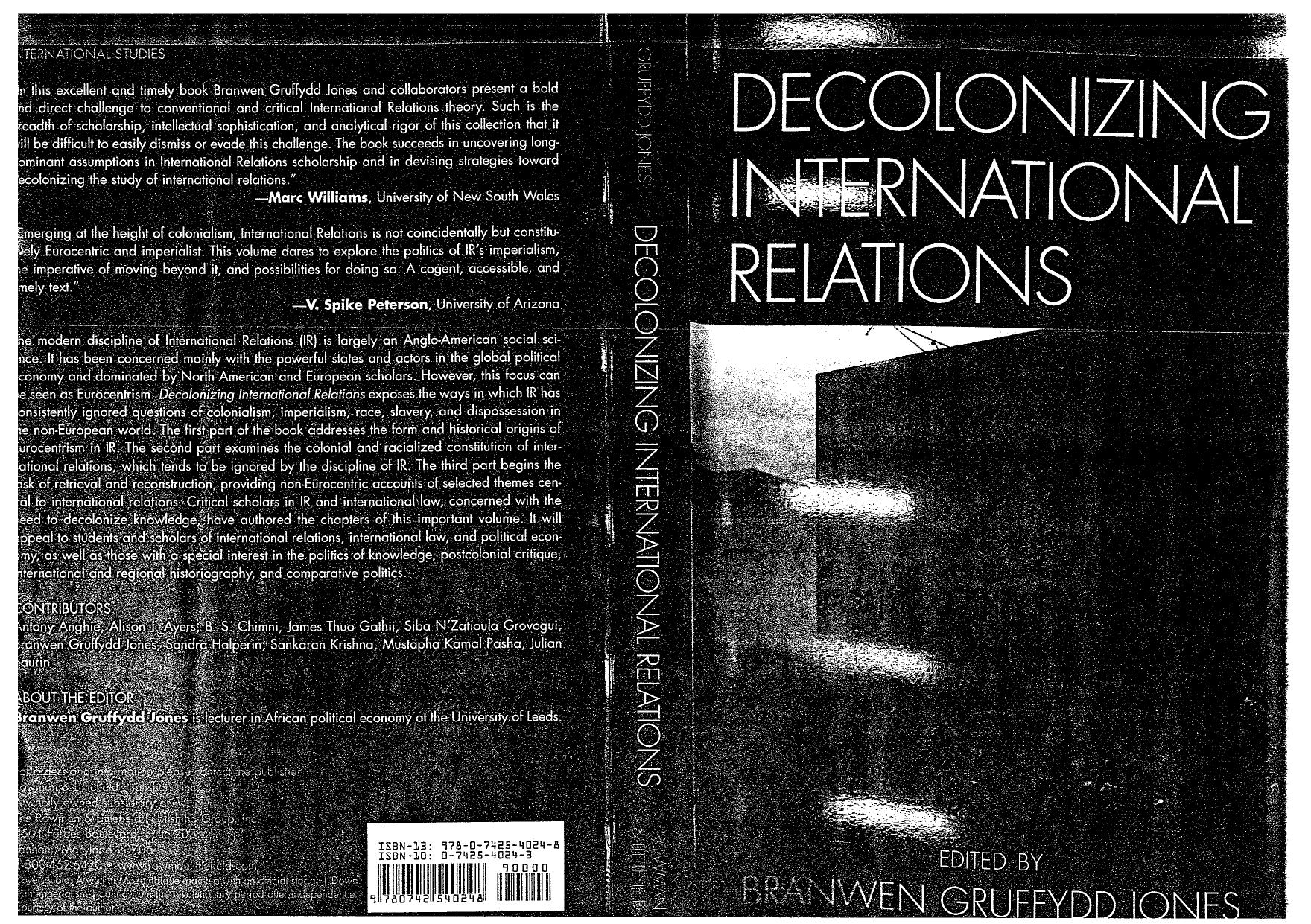
Decolonizing International Relations by Branwen Gruffydd Jones
Author:Branwen Gruffydd Jones [Jones, Branwen Gruffydd]
Language: eng
Format: epub, pdf
Publisher: Rowman & Littlefield Publishers
Published: 2006-09-15T00:00:00+00:00
HEGEMONIC EROSION OF A CUSTOMARY INTERNATIONAL LAW CANON DURING THE TWENTIETH CENTURY
The classical customary international rule forbidding the extinction of contracts and private property rights on conquest has been undermined by uneven and inconsistent application. One of the reasons advanced for this inconsistency is that the rule is ancient and therefore does not reflect the practice of states in all cases.17 The Hague Regulations were negotiated at the end of the nineteenth century at a time when it was in the interest of the United States to comply with rules of international law.18 Some have argued that the subsequent growth of the political and economic power of the United States justifies a less significant role for international law in governing the U.S. role in international affairs.19 One commentator has concluded that international law serves as a tool for U.S. power as opposed to a restraint of U.S. power in the world today.20 Thus today, almost a hundred years after the Hague Regulations came into force, the United States asserts its global military and political dominance unilaterally in a manner unthinkable a century ago.21 This global dominance, according to adherents of this view, has resulted in reducing the constraints of international law on the United States.22
Twenty-first century warfare, as conducted by powerful countries such as the United States, is vastly different from nineteenth-century warfare. It has been argued that high-tech warfare is more precise, with a decrease in the death of civilians and destruction of their private property. However, the trebled lethality of high-tech warfare has in fact multiplied rather than reduced the impact of war on civilian populations and property for various reasons.23 First, powerful states with such weaponry have made sophisticated legal arguments to justify narrowing distinctions between soldiers and civilians that legitimize civilian casualties and destruction to civilian property as collateral damage.24 Countries such as the United States have adopted doctrines justifying the use of overwhelming military force, including using unchallenged heavy precision-guided aerial bombs and missiles to support few but well-equipped battalions in enemy territory.25 Second, the traditional humanitarian constraints on the use of military force have been mobilized to lend credibility to new visions of military necessity and military action.26 As Upendra Baxi and others have argued, the post-Cold War doctrine of militarized humanitarianism has had adverse human rights and economic consequences for nondominant cultures and peoples.27
In the nineteenth century, the classical rule restricting the vitiation of contracts and private property on conquest was founded on the view that war occurred between states. While there are instances in the history of international relations where armed force was exercised against nonstate actors, such as the threat of piracy,28 the War on Terrorism declared after September 11, 2001, by the United States and later endorsed by the United Nations has contributed to the continued erosion of the view that war occurs between states.29 The War on Terrorism has come to be defined almost exclusively as against nonstate actors. The Bush administrationâs National Security Strategy of 2002 states,
The enemy is not a single political regime or person or religion or ideology.
Download
Decolonizing International Relations by Branwen Gruffydd Jones.pdf
This site does not store any files on its server. We only index and link to content provided by other sites. Please contact the content providers to delete copyright contents if any and email us, we'll remove relevant links or contents immediately.
| Anthropology | Archaeology |
| Philosophy | Politics & Government |
| Social Sciences | Sociology |
| Women's Studies |
Cecilia; Or, Memoirs of an Heiress — Volume 1 by Fanny Burney(32558)
The Great Music City by Andrea Baker(32018)
Cecilia; Or, Memoirs of an Heiress — Volume 2 by Fanny Burney(31956)
Cecilia; Or, Memoirs of an Heiress — Volume 3 by Fanny Burney(31941)
We're Going to Need More Wine by Gabrielle Union(19046)
All the Missing Girls by Megan Miranda(16023)
Pimp by Iceberg Slim(14506)
For the Love of Europe by Rick Steves(14121)
Bombshells: Glamour Girls of a Lifetime by Sullivan Steve(14073)
Talking to Strangers by Malcolm Gladwell(13370)
Norse Mythology by Gaiman Neil(13363)
Fifty Shades Freed by E L James(13239)
Mindhunter: Inside the FBI's Elite Serial Crime Unit by John E. Douglas & Mark Olshaker(9339)
Crazy Rich Asians by Kevin Kwan(9291)
The Lost Art of Listening by Michael P. Nichols(7506)
Enlightenment Now: The Case for Reason, Science, Humanism, and Progress by Steven Pinker(7311)
The Four Agreements by Don Miguel Ruiz(6765)
Bad Blood by John Carreyrou(6621)
Weapons of Math Destruction by Cathy O'Neil(6279)
